

Electromagnetic Latch Lock - 12V DC
$16.95$13.56
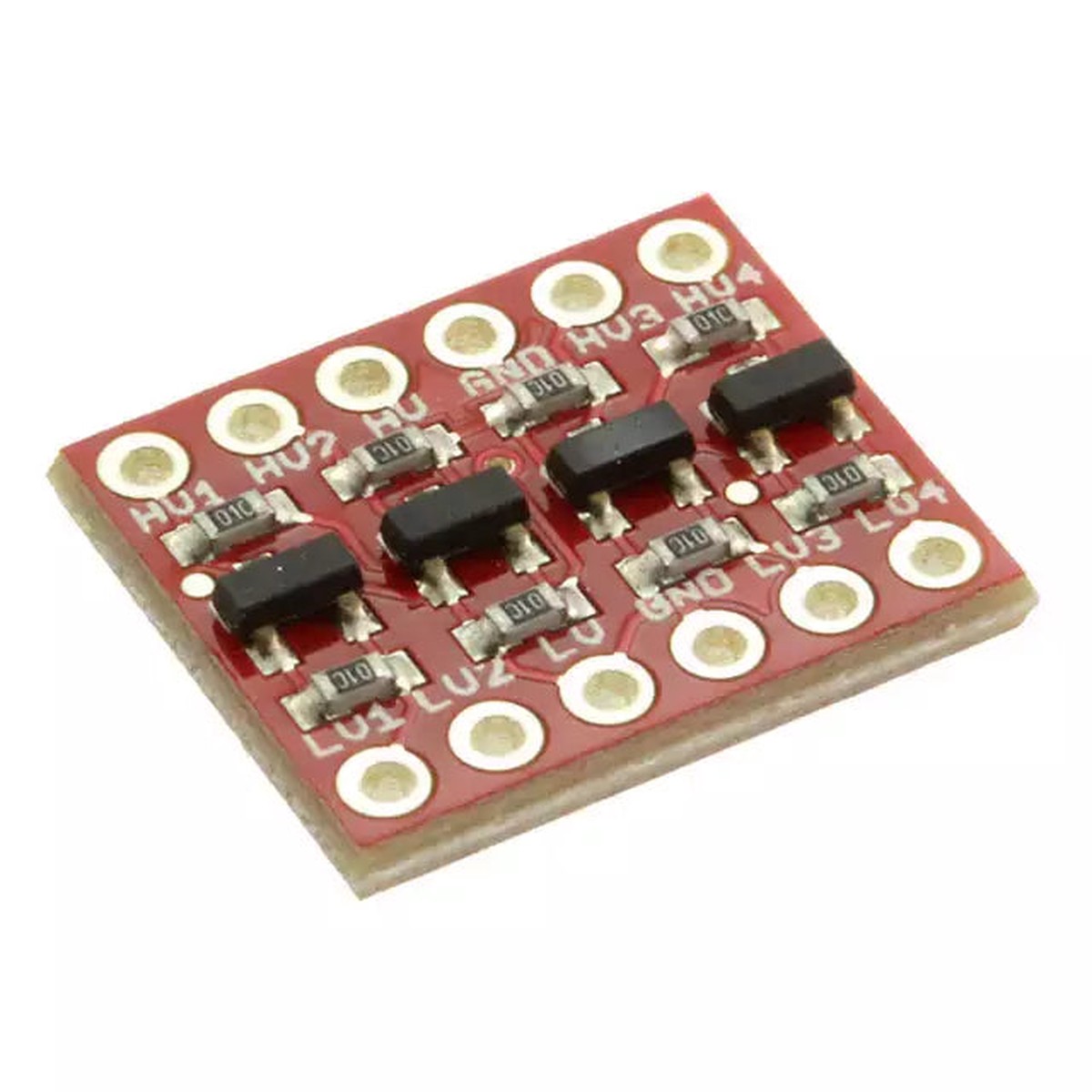
This 4-channel bi-directional logic level converter allows microcontrollers and digital devices operating at different logic voltages to communicate safely. It is commonly used to connect 3.3V ESP32, Raspberry Pi and other 3.3V systems to 5V sensors, modules and microcontrollers.
Important: This module does not generate 5V from 3.3V. It is a logic signal converter, not a voltage boost converter. The board requires both voltage rails to be supplied by your project. For a typical ESP32-to-5V application, connect 3.3V to the LV pin and 5V to the HV pin.
Want a version that lets you connect a 5V module to your ESP32 without an external power supply? Look at this option.
The BOB-12009 requires a low-voltage reference and a high-voltage reference in order to translate signals between the two voltage levels.
The module uses these voltage rails as references for the logic conversion. It does not contain a boost converter or voltage regulator that creates the high-voltage supply.
If your project only provides 3.3V and you need both a 5V power supply and 5V logic, you will need a separate 3.3V-to-5V boost converter or a logic level converter with an integrated boost converter.
ESP32 microcontrollers use 3.3V logic, while many sensors, displays and other electronic modules are designed for 5V logic. This converter provides a way to interface the two systems when both 3.3V and 5V power rails are available.
A typical ESP32 connection would be:
For example, a signal connected to LV1 on the 3.3V side corresponds to HV1 on the 5V side.
A logic level converter, also called a logic level shifter or voltage level translator, changes the voltage level of digital signals so devices using different logic voltages can communicate.
This is different from converting power-supply voltage. A logic level converter changes signal voltage. A boost converter changes power-supply voltage.
The BOB-12009 provides four separate bi-directional signal channels. Signals can pass from the low-voltage side to the high-voltage side or from the high-voltage side to the low-voltage side without a separate direction-control input.
This makes the module particularly useful for bi-directional communication buses such as I2C.
This MOSFET-based bi-directional level converter is particularly well suited to I2C and other open-drain signals. It can also be used with many UART and general-purpose digital signals.
For high-speed SPI or other timing-sensitive digital interfaces, verify that this type of level-shifting circuit is suitable for the required signal speed and electrical characteristics.
This distinction is important when selecting a module for an ESP32 project.
This BOB-12009 translates logic signals between two voltage systems that already exist. It does not create the second voltage.
If your ESP32 project has both 3.3V and 5V available, this module can translate signals between those voltage levels. If your project has only a 3.3V supply and you need to power a 5V device, you will also need a boost converter or another module designed to generate 5V.
The BOB-12009 is a compact solution for connecting compatible ESP32, Arduino, Raspberry Pi, sensors and other mixed-voltage digital electronics. Before selecting this module, confirm that your project provides both the low-voltage and high-voltage supplies required by the converter.
There are no reviews yet. Be the first to review this product!
Add a review
Your email address will not be published. Required fields are marked *